.png)

How to Write a Nonprofit Case for Support (+ Free Template)
If you have ever stared at a grant application wondering how to explain your organization from scratch—again—you are not alone.
Many nonprofits spend dozens of hours rewriting the same organizational story for grant proposals, donor conversations, corporate sponsorships, annual appeals, and website content. The wording changes slightly from deadline to deadline, but the underlying questions rarely do.
That is where a case for support comes in.
A well-crafted case for support serves as the foundational narrative for nearly every funding conversation your organization will ever have. Instead of reinventing the wheel each time, you build one clear, compelling document that can be adapted across countless fundraising opportunities.
What Is a Nonprofit Case for Support?
A case for support is a foundational document that clearly explains why your organization exists, the community problem it addresses, how it achieves measurable results, and why financial investment is needed.
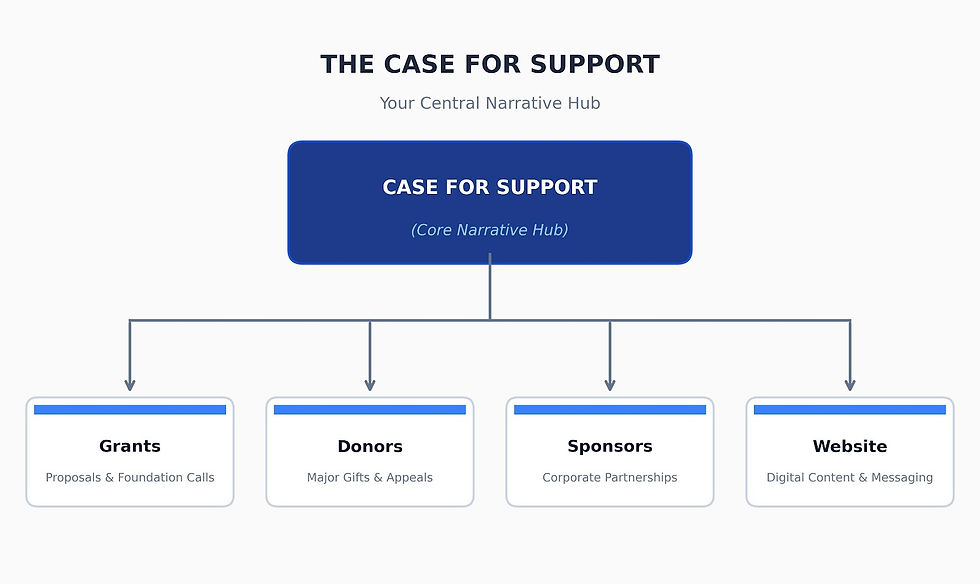
Unlike a grant proposal written for a specific foundation, a case for support is not tied to a single funder. Instead, it becomes the central narrative that guides your fundraising communications, providing the foundation for:
✔ Grant applications and major gift conversations
✔ Corporate sponsorship proposals and annual appeals
✔ Board onboarding, website content, and public presentations
Think of it as the bedrock upon which all your fundraising communications are built.
Why Your Organization Needs One
Operating without a case for support leaves your team constantly reacting to new writing demands. One funder wants organizational history, another asks for community demographic data, and a major donor wants proof of impact.
By taking the time to write a centralized case for support, your organization gains several key advantages:
✔ Consistency: Ensures staff, board members, and volunteers tell the same story across all communications.
✔ Efficiency: Dramatically reduces drafting time by providing pre-approved language for proposals and appeals.
✔ Onboarding Ease: Helps new staff and board members quickly understand your organization’s mission, approach, and impact.
✔ Stronger Materials: Produces stronger fundraising materials because your messaging is prepared before deadlines arrive.
Looking for a place to start? Download our free Case for Support Template to build your first draft as you work through this guide.
What Should a Case for Support Include?
While every organization is unique, an effective case for support includes seven essential narrative elements.
1. Begin with a Strong Opening
Introduce your organization and the change it is working toward. Help the reader quickly understand who benefits from the work and why it deserves attention.
2. What Problem Exists?
Begin by establishing the community need. Describe who is affected, why the issue matters now, and why action is necessary. Anchor your problem statement in local data and community evidence rather than broad assumptions.
3. How Does Your Organization Respond?
Explain your organization’s approach, including the programs or services through which it responds. Rather than presenting an exhaustive list of activities, focus on how the work directly addresses the community need outlined above.
4. What Difference Does Your Work Make?
Show concrete results. Evidence builds confidence, so highlight measurable outcomes, community-wide impact, participant success stories, and major organizational accomplishments.
5. Why Your Organization?
Explain why your organization is well positioned to address this problem. Highlight your track record, key community partnerships, specialized expertise, and leadership.
6. Why Is Funding Needed?
Connect financial support directly to the work and impact already described. Instead of making a broad plea for funding, demonstrate how an investment expands, strengthens, or sustains your organization’s work.
7. What Is the Closing Invitation?
Conclude with a clear invitation. Whether the audience is an individual donor, foundation officer, or corporate partner, the reader should understand what you are inviting them to do and what their support will help make possible.
For a more detailed breakdown of the information a comprehensive document may contain, read What Should a Nonprofit Case for Support Include?
Common Pitfalls to Avoid
Many nonprofits unintentionally weaken their messaging through a few recurring mistakes.
The most common trap: describing program logistics before establishing why the problem matters in the first place. Always lead with the community need.
Beyond mis-ordering the story, watch out for these common pitfalls:
Pitfall | Why It Harms Your Case | How to Fix It |
Listing only actions without outcomes | Focuses on your actions instead of what changed. | Shift from describing activities to demonstrating results. |
Broad claims without evidence | Reduces credibility and sounds promotional. | Support key statements with current data and examples. |
Too much detail | Makes it difficult for readers to identify the main message. | Keep the document focused on your primary story. |
Insider jargon | Confuses readers unfamiliar with your work. | Write for someone learning about your organization for the first time. |
Streamline Your Writing Process
Building this foundational document does not have to be overwhelming. To help you organize your ideas into a polished first draft, we have put together a free Case for Support Template.
This guided toolkit includes section-by-section prompts, recommended word counts, guided questions, and a final review checklist to keep your narrative sharp and effective.
Completing your case for support is a major milestone, but it is just the beginning. When your core narrative, impact metrics, and organizational story live in a structured system, all future fundraising becomes faster, more consistent, and infinitely easier to manage.


